Barong and Rangda: The Story Behind the Dance
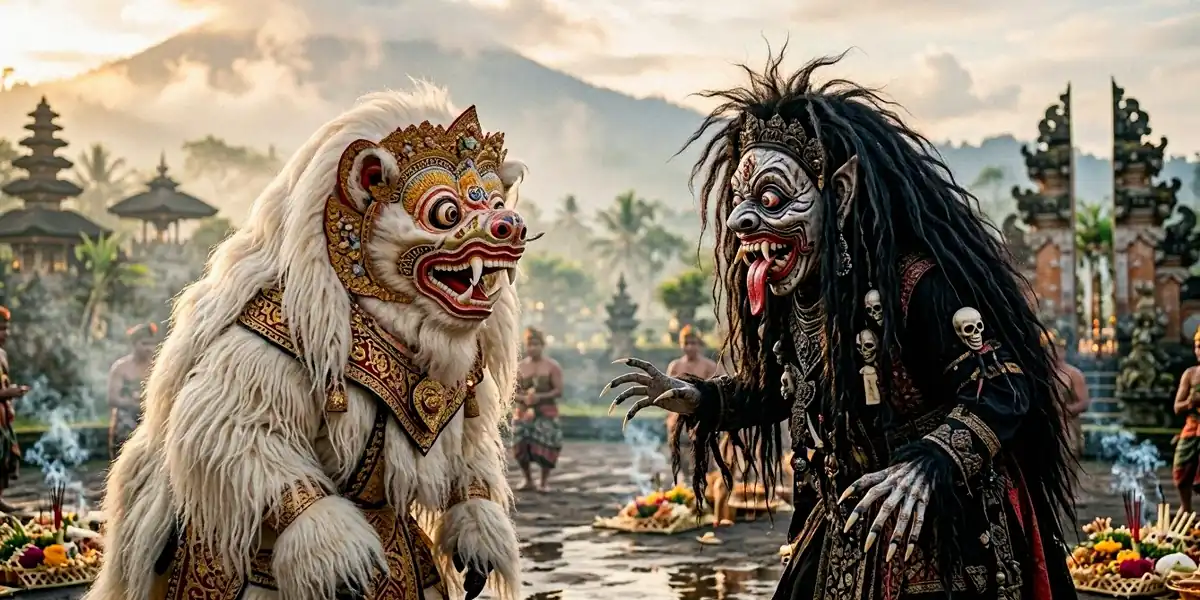
The gamelan strikes up before the crowd has even settled. A procession of villagers in white and gold moves through the temple gates, and then the Barong appears — a shaggy, lion-like creature with a snapping jaw and eyes that seem to follow you across the courtyard. Two dancers move its head and tail in perfect sync, and children squeal, half delighted, half terrified. It’s a scene we’ve watched dozens of times in Ubud, Bali, and it never loses its grip. But what does this ancient battle between good and evil really mean? The answer goes deeper than most visitors expect.
The Eternal Battle: Good vs. Evil in Balinese Cosmology
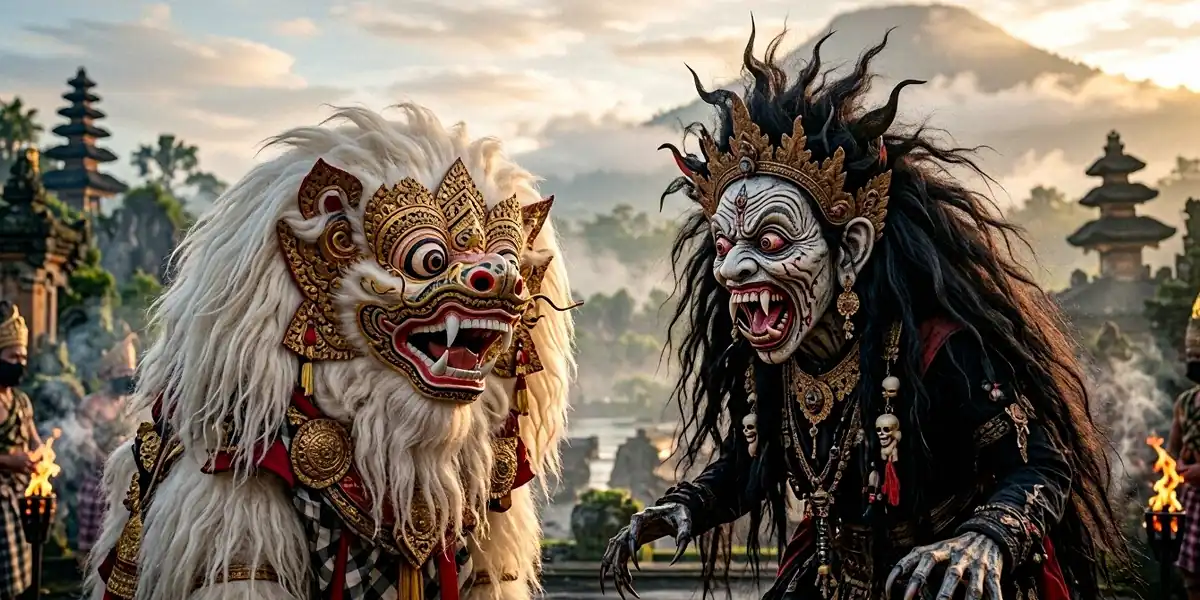
Western audiences tend to read stories in terms of winners and losers. Balinese cosmology doesn’t work that way. The Barong and Rangda performance isn’t a fight to the death; it’s a ritual dramatisation of a balance that must be constantly maintained. Understanding that changes how you watch the whole thing.
Rwa Bhineda: The Balance of Opposites
The philosophical concept at the heart of the performance is Rwa Bhineda — literally “two opposites” or “two different things.” Balinese Hinduism holds that forces like good and evil, light and dark, creation and destruction, don’t cancel each other out. They coexist, and the universe depends on their tension. Barong and Rangda are not enemies in the way a superhero and a villain are enemies. They are two halves of a whole, and the dance ends without a clear victor because a clear victor would mean cosmic imbalance.
Barong: The Protector Spirit
Barong is the embodiment of dharma — order, goodness, protection. He is a benevolent spirit guardian who watches over villages and temples. In performance, he is playful as often as he is fierce: he nuzzles children, snaps at offerings, and dances with a lightness that contrasts sharply with what comes later. Barong represents the protective forces that keep a community safe.
Rangda: The Demon Queen
Rangda is the widow-witch, the queen of the leyak (spirits associated with black magic), and the embodiment of adharma — chaos and destruction. Her backstory is tragic rather than purely villainous: in some tellings she was a queen who was wronged, and her rage curdled into demonic power. She represents the forces that threaten a community, but she is also necessary. Without Rangda, there is no Barong, and without the struggle, there is no balance.
The Characters and Their Sacred Masks
Every Barong mask is a sacred object, not a prop. Before a mask is worn, it is blessed, offered incense, and treated with the reverence you’d give a temple statue. The masks are usually kept in a temple or a village’s sacred storehouse, and bringing one out for a performance is itself a ritual act.
Barong Ket: The Lion Protector
The most common form you’ll see is Barong Ket, the lion-like figure with a red face, gilded crown, and a body covered in hundreds of strands of hair made from palm fibre or, in finer versions, human hair. His jaw clacks rhythmically, driven by the front dancer, while the rear dancer controls the tail and hindquarters.
Rangda: The Fanged Terror
Rangda’s mask is deliberately unsettling: bulging eyes, a protruding tongue, long fangs, and a mane of white hair that hangs almost to the ground. Her performance is accompanied by a distinctive, grating gamelan melody that signals her arrival. When she laughs — a high, cackling sound — it’s one of the most memorable moments in Balinese performance.
The Sanctity of the Masks
Before a Barong mask is worn, a pemangku (temple priest) typically performs a blessing with holy water and incense. Some masks are considered so sacred that they are only brought out on specific ceremonial days, and some are never photographed. If you’re watching a performance and a mask is covered or a ritual is happening before the show, that’s not a photo opportunity — it’s a sacred moment.
The Performance: A Journey Through the Story
A full Barong and Rangda performance runs anywhere from 45 minutes to over an hour, depending on the venue and the version of the story being told. Here’s how a typical performance unfolds.
The Gamelan Orchestra Sets the Scene
The performance opens with the gamelan orchestra — a percussion ensemble of metallophones, gongs, drums, and flutes. The music isn’t background; it drives the entire narrative, shifting tempo and mood to signal every character entrance and emotional beat. Listen for the kendang (drum), which effectively conducts the dancers.
The Arrival of Barong and Rangda
Barong enters first, often accompanied by a pair of playful monkey-like attendants. The story then introduces other characters — servants, a pair of brothers, sometimes a penasar clown figure who provides comic relief and translation for the audience. Rangda appears midway through, and the tension escalates. The two confront each other, but the fight is never resolved in a simple way.
The Keris Dance: Trance and Invulnerability
The climax is the keris dance. Several men — the pengelings — enter a trance state and turn their ceremonial daggers (keris) on themselves. In trance, they are believed to be protected from injury, and the daggers don’t pierce the skin. A priest or attendant is always present to bring them out of trance safely. It’s genuinely dramatic, and it’s the moment most visitors remember longest.
Where to See Barong and Rangda in Bali
You’ll find performances all over the island, but the quality and authenticity vary enormously. Here are the venues we recommend to Australian travellers.
Ubud: The Cultural Heart
Ubud is the most convenient base. Pura Dalem Ubud hosts a well-regarded evening performance several nights a week, staged in a temple courtyard that gives the whole thing a genuinely ceremonial atmosphere. Arrive early for a good seat, and bring a light layer — evenings can be cool after the heat of the day.
Batubulan: The Barong Village
Batubulan village, about 20 minutes from Ubud, is famous specifically for its Barong performances and has been staging them for tourists and locals alike for decades. Morning shows are popular with day-trippers heading north, and the village’s reputation for authentic performance is well-earned.
Other Venues and Festivals
Bali Safari & Marine Park offers a more polished, family-friendly version, useful if you’re travelling with kids or on a tight schedule. Beyond the tourist circuit, temple festivals (odalan) often include Barong performances — if you’re lucky enough to be invited to one, accept, dress respectfully, and follow your host’s lead.
Understanding the Trance and Spiritual Significance
For Balinese communities, the performance isn’t theatre in the Western sense. It’s a ritual that serves a protective function, and the trance states you see are real religious experiences, not acting.
The Role of the Pemangku (Priest)
The pemangku oversees the spiritual safety of the performance. He blesses the masks, the dancers, and the space itself, and during the keris dance he is responsible for bringing trance dancers back to normal consciousness. Without his presence, the performance would be considered incomplete — and potentially unsafe.
Trance: A Sacred State
Trance in Balinese performance is understood as a form of possession by protective spirits. The pengelings who stab themselves with keris are believed to be shielded by these spirits. After the performance, they often have no memory of what happened. It’s not a trick, and it’s not hypnosis in the clinical sense — it’s a culturally embedded religious practice.
Barong as a Community Guardian
Many villages keep their Barong mask as a protective talisman. When disease, disaster, or misfortune strikes, the Barong may be paraded through the village in a ngerupuk procession to cleanse the area. The performance you watch is, in a real sense, a public demonstration of that ongoing guardianship.
Tips for Australian Travellers: Etiquette and Enjoyment
Australians are generally pretty relaxed about dress and formality, but Balinese temple performances do have expectations. A little awareness goes a long way.
What to Wear and How to Behave
- Wear a sarong and sash if you’re entering a temple venue — most performances provide them, but it’s easier to bring your own.
- Cover shoulders and knees. Singlets and short shorts are not appropriate inside temple grounds.
- Sit lower than the priest or offerings if you’re near the front, and don’t step over offerings on the ground.
- Avoid pointing your feet at performers or the altar — it’s considered disrespectful.
- Keep your voice down during the performance, especially during trance sequences.
Photography: Dos and Don’ts
Flash photography is usually banned, and you should never use a flash during trance sequences — it can disrupt the dancer’s state. If a sign says no photography, respect it. Video is often permitted, but check with the venue first. And if you’re at a temple ceremony rather than a tourist show, ask before you raise your camera.
Choosing an Authentic Performance
Bigger isn’t always better. A temple performance in Ubud or Batubulan will usually feel more genuine than a resort show, even if the seating is less comfortable. Look for performances that include a live gamelan orchestra (not recorded music), a real pemangku, and a full keris dance. If a venue advertises a “condensed 30-minute version,” you’re getting the highlights reel, not the ritual.
FAQ
Is the Barong and Rangda performance suitable for children?
Generally yes, but the keris dance and Rangda’s appearance can be frightening for younger kids. Many venues in Ubud and Batubulan are family-friendly, and the comic penasar characters usually keep things light between the intense moments.
How long does a typical performance last?
Most full performances run between 45 and 75 minutes. Tourist-oriented shows at places like Bali Safari & Marine Park may be shorter, while temple performances during festivals can run considerably longer.
Do I need to book tickets in advance?
For popular Ubud venues like Pura Dalem Ubud, booking a day ahead is wise during peak season (June–August and December–January). Batubulan morning shows often accept walk-ins, but group bookings can fill up.
Can I take photos during the trance dance?
Usually yes, but without flash. Some venues ask guests to put cameras away entirely during the keris dance out of respect for the dancers’ spiritual state. Always follow the venue’s instructions and any signs posted.
Is the keris really not piercing the skin?
In the trance state, the dancers are believed to be protected by spirits, and in most performances the daggers genuinely do not break the skin. It’s a religious phenomenon, not a stage trick, and should be observed with respect rather than scepticism.
Barong and Rangda is far more than a tourist show. It’s a living tradition that carries centuries of Balinese philosophy, ritual, and community identity — and watching it with a bit of context transforms the experience entirely. Whether you catch a performance at Pura Dalem Ubud, a morning show in Batubulan village, or a festival in a quiet village temple, go with respect and curiosity. You’ll come away with a deeper sense of why this dance has survived, and why it still matters to the people who perform it.